Before I launch into all the details on these incredible free 11th grade homeschool curriculum options, you might want to read my perspective and background, first. TLDR version: Our kids have been in public schools, in private schools, and homeschool.
You probably know that homeschool can be pretty expensive if you don’t know where to look. But you don’t have to buy a huge, expensive boxed curriculum or join a pricey online school. The truth is, there are some really great resources out there that won’t cost you anything. That said, we do recommend joining a co-op or tutorial for your kids to have a chance to connect with other students their age during the week!
Another option to look into for 11th and 12th graders is dual enrollment classes. In the state of Tennessee, students can get grants from the state to take dual enrollment courses for free—and your child can satisfy high school credits while earning college credits at the same time. I highly recommend taking dual enrollments for the HS graduation requirements that double as college general education requirements — things like English Composition 101 and 102, Western Civilization (HS World History) or American History, or maths. That way, they can start college ahead of the game.
Note: I’m basing this 11th grade plan on Tennessee state requirements for graduation at the time of publication. Please consult your homeschool umbrella or other consultant before making final class choices, especially concerning dual enrollment courses! Not all states are the same.
More like this: How to homeschool for free, 9th grade curriculum and How to homeschool for free, 10th grade curriculum
Math (2 semesters, 1 credit)
Khan Academy has an incredible range of math classes for students in high school. You’ll likely be looking at Geometry or Algebra II for 11th grade, but they have classes all the way through AP/College Statistics and multivariable calculus. Each unit has video lessons, practice problems, and quizzes. It’s all self-paced and a great option for students who are able to learn from video and pace themselves to finish on time without a huge amount of oversight from mom.
Another option is grabbing some very inexpensive, used Saxon Math textbooks from your local used book store and using this incredible online self-grading resource for the homework, or checking into dual enrollment options in your state.
English (2 semesters, 1 credit)
Many schools offer American Literature during junior year. Check local schools to see what books they’re reading and look online at packaged curriculums to see what they include in their American Lit courses. My favorites are Beautiful Feet, Memoria Press, Brave Writer, or Tapestry of Grace.
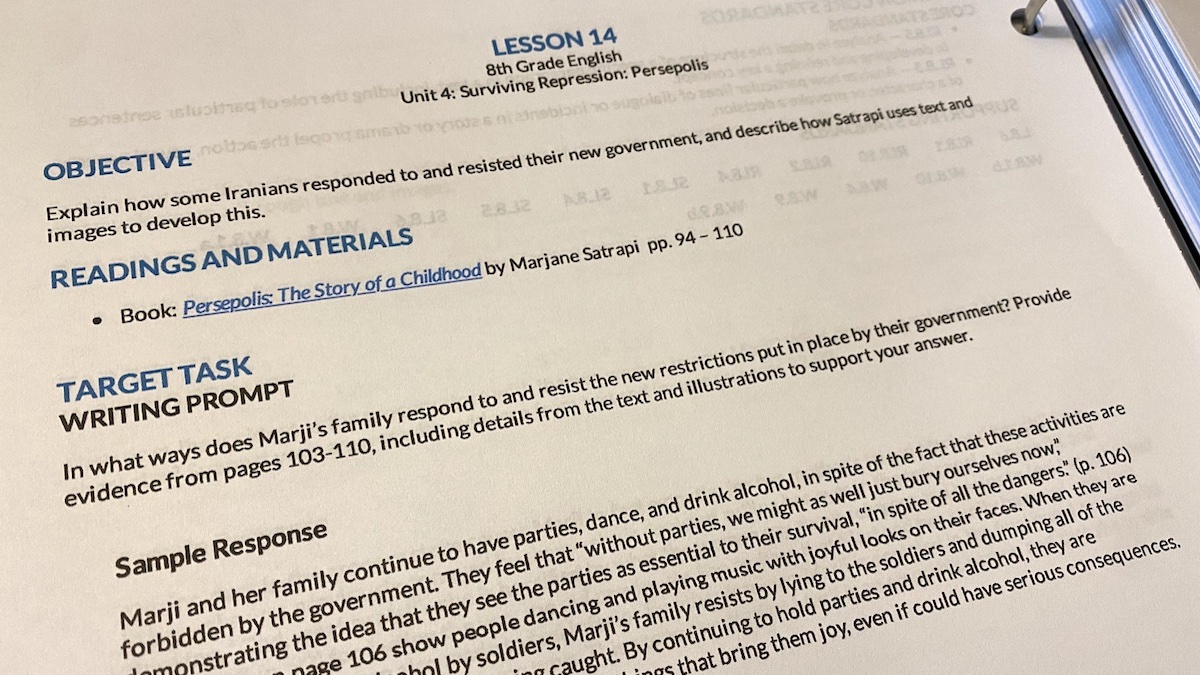
Once you have your book list nailed down, head over to Fishtank Learning or Common Lit. Both sites are built for public school teachers and have seemingly endless resources. You can search by book, by grade, or (on Common Lit) by genre to find teaching aids for the texts you want your child to read. Both have really nice suggestions for paired readings to go along with your main texts. Common Lit even has entire curriculum for each grade available completely free.
You can also frequently find teaching guides available for free from the publisher of the books you’re interested in; just Google the book title, publisher name, and “teaching guide” or “teacher resources” and you’ll likely find some really good resources.
For the writing component, both Fishtank and Common Lit have writing assignments built into their curriculum, but many kids I know opt to take English 101 and 102 dual enrollment in their junior year. In my home state of TN, the government offers grants to cover the costs of your first 5 dual enrollment courses, so it’s completely free.
More like this: To Kill a Mockingbird unit study
Science (2 semesters, 1 credit)
I think science classes are one of the hardest to do from home if you’re trying to incorporate labs, which most colleges will want on a student’s transcript. The great news is that Khan Academy has great science classes for free online. For junior year, most kids would choose Physics (or AP Physics). Khan even has a whole section dedicated to hands-on Physics activities.
Physics isn’t your only option, though. Many kids choose AP Environmental Science or Anatomy & Physiology, which you can find for just $25 at Carnegie-Mellon’s Open Learning Initiative.
To complete the labs, get creative. You can do many of them virtually online (this is how most of my daughter’s Biology labs were done at her top-ranked public school, FYI), get a group of friends to meet together once a month for a fun Physics Lab Day, or ask your co-op to offer a lab-only companion to Physics class. A friend who teaches HS science at a nearby college-prep private school says she does 8-10 labs per year in her course.
History (2 semesters, 1 credit)
This is the year most students would do an American history credit. Khan Academy has an AP US History course for free on their site. PBS Learning Media has a collection of US History resources for high school kids. And the Gilder Lehrman Institute of American History has a free self-paced US history course with video lectures, primary sources, and quizzes.
Another not-quite-free but not too expensive option is Beautiful Feet’s Modern US and World History for high school. It’s a literature-based approach to US history, and the teacher’s guide is just under $25. You can check out all the accompanying books at the library. (Note that the early American edition, which covers the beginnings of American history, is designed for grades 7-9.)
Foreign Language (0 credits)
Most kids get their foreign language knocked out their freshman and sophomore years. To continue on to a year 3 will likely cost you a fee for a class. For info on foreign language, check our post on how to homeschool 9th grade for free.
More like this: How I taught middle school Geography at our homeschool co-op
Lifetime Wellness (2 semesters, 1 credits) and PE (1 semester, 0.5 credits)
Lifetime Wellness is a required credit in Tennessee. The Tennessee state standards for this course are really detailed and even include activities to do. The requirement for PE is 75 hours of physical exercise. Keep a log, and you’ll be covered there!
Another option here is to check out health-related BSA merit badges, including Personal Fitness, Public Health, First Aid, and so on.
Electives
I like to have my high schoolers do at least one elective each year, of their choosing. To qualify for a full credit, your child should spend 150 hours in this subject. Here are some ideas for you:
- join a theater group and participate in a play — Fine Arts
- have your child look for an internship at a business in the career field they’re interested in
- take a cooking class at your community center, or have your child plan and prepare meals once a week for the year — Culinary Arts
- check out a book on creative writing and follow the prompts, start a “Writer’s Circle” and share creative writing projects with friends regularly — creative writing
- complete one of the many computing classes on Khan Academy
- watch through the AFI top 100 list and learn about the history of movies — American Film Studies
- choose any of the BSA merit badges and create an elective around that (you don’t have to be a scout to use these resources!)
- If they are involved in an extracurricular, use that experience! One friend created an “Outdoor Leadership” course based on her son’s 2 high adventure trips, his year as BSA troop SPL, and his work on his eagle project.
- take an extra science, like psychology or astronomy, for a special area of focus
- create your own business — Entrepreneurship
If you have any other great tips or resources you’ve used personally, please mention them in the comments below!
 Spilled Milk